

Meiway, the music genius of Cote d’Ivoire
BY MICHAELA BEWA

On March 17, 1962 in Cote d’Ivoire’s coastal city of Grand-Bassam, West Africa, a boy was born in the Ehui family. His parents named him Frederick Desire. The baby’s parents were music lovers. The father was an amateur accordion player, and his mother sang in her church’s choir. It appeared the boy had mujsic in his veins, for at age 9 he was already singing in his mother’s church choir. Thirty years later he turned out, indeed, to be one of Cote d’Ivoire’s, sorry, Africa’s most prominent musicians. He created a beat called “Zoblazo,” and renamed himself Meiway. Well, it didn’t happen that easily.
At age 20, Meiway created his first group, “Les Genitaux,” which won the 1981 “Podium” Award, an Ivorian music prize very sought after by the youth. Galvanized by the early success, Meiway soon flew to Paris. There, he founded another group that he named “Defense Ivoire,” with the clear objective of heralding African culture. But it was a multi-cultural group consisting of Sub-Saharan, Algerian and French musicians.
Money, obviously, is the name of the game. So Meiway got a loan from a bank to launch his first album, “Ayibehou,” in 1989. This earned him the “Best Ivorian Singer” award in 1990, with his group renamed “Zo Gang.”
Meiway’s musical genre, “Zoblazo,” dates back to that year. It is a blend of several types of Cote d’Ivoire’s music, but primarily from his own ethnic group, Appolo. The rhythm is a combination of percussion, with dance having a say in the show. But the music grew larger, as the artist incorporated elements of folklore from other parts of the sub-region and beyond. He coined the expression “World Music Zoblazo” rich with fanfare, “grolo,” “sidder” or “abodan.” The whole thing is wrapped up in modern music, with his dancers carrying a white handkerchief, a sign of joy and purity.
Meiway, a hard-working entertainer, kept improving on his music style. That led to his second album, “200% Zoblazo” released in 1991, followed by the third one in 1993 titled “Jamais 203-300% Zoblazo.” In 1995 emerged “Appolo 95” in “400% Zoblazo.” In 1996 he won the “Best Regional Artist Award” during the African Musical Award.
The artist kept on climbing the ladder of success. He turned to his ancestors and released the hit “Les Genies vous parlent” in “500% Zoblazo” in 1997. He innovated by adding the Senegalese “Mbalax” beat to the “Zoblazo” and “High-life” sounds. In 1998, Meiway released yet another album titled “Hold Up.” The entertainer reached a milestone. That year brought a bunch of recognitions. He alone received three awards at the 1998 Kora Musical Awards held in Sun City, South Africa: “Best Regional Artist, West Africa,” “Best Arranger,” and “Best Video.” Still in 1998, in the month of December, Meiway got the “Best African Video Award” during the Sixth edition of the “African Musical Awards” held in his country.
In 2000, Meiway crowned his decade-long career with an album titled “Extra Terrestre” cooked in a heavy Latino sauce, the cords and the horns being the work of Cuban musicians. Then came “Eternel,” his current album that got his fans everywhere dancing to the tune of the hit “Miss Lolo.”
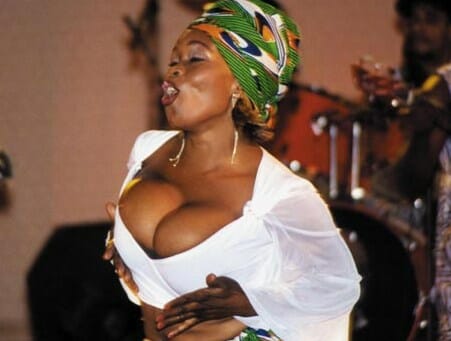
Meiway performs on stage like a machine, with incredible energy and talents. The African witnessed that first-hand during the star’s performance recently in Lome, the capital of Togo, in West Africa. Meiway and his sexy – yes, provocative – dancers kept the audience literally on their feet for two hours non-stop. The entertainer played hits from his last album, “Eternel,” as well as hits from old ones. “Vis-a-vis,” “Abidjan Koteba,” “Gbotemi,” and especially “Miss Lolo” turned the audience wild. Dance is an essential part of Meiway’s shows, and the Lome audience did not fail to bring the famous white handkerchief, which they shook to the tune of the music.
The show reached its climax when the entertainer dashed into the crowd, to the delight of the fans who formed small groups of dancers in the room. In fact, some spectators simply stood up throughout the performance.


Soumanou Salifou (administrator)
Soumanou is the Founder, Publisher, and CEO of The African Maganize, which is available both in print and online. Pick up a copy today!